
































(Designed by Daniel Hassoun)
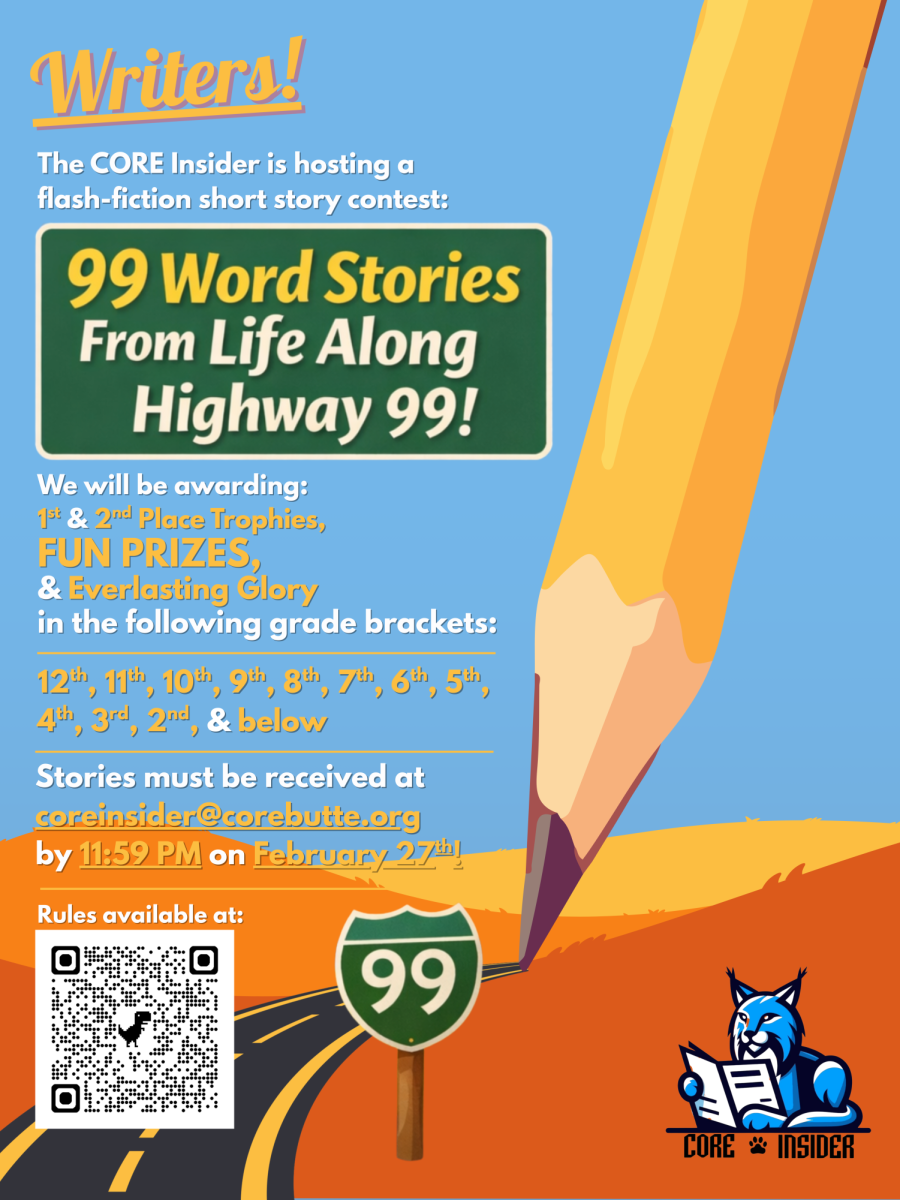
Writers! Welcome to CORE Butte’s flash-fiction short story contest: 99 Word Stories From Life Along Highway 99!
The CORE Insider will be awarding 1st and 2nd place trophies, prizes, and everlasting glory to the writers of the best 99-word stories in the following grade brackets: 12th, 11th, 10th, 9th, 7th & 8th, 5th & 6th, 3rd & 4th, and 2nd and below.
Rules:
- You may submit up to two stories for consideration. Put them on the same document, with your first and last name, your grade level, and your Homeroom teacher/PLT’s name.
- Stories must be received by 11:59 PM on February 27th. Send them to [email protected] with “99-word stories” in the subject line.
- Each story must have a title. The words in the titles DO NOT count toward the word counts.
- Your stories must each be exactly 99 words; not one more or less.
- They must be stories, meaning something must happen; there must, in some way, be a beginning, middle, and end.
- Contractions like “don’t” count as one word.
- Hyphenated words or phrases like “32-year-old” count as one word.
- Your stories must be ENTIRELY written by you; no AI, not even Grammarly, to “clean it up.”
- It must be new work—do not use something you wrote for another class or at another time.
- No “fan fiction”: do not pilfer plotlines, characters, or worlds from other writers, shows, etc. Gandolf should make an appearance.
- You CAN write in any genre, including fantasy, mystery, or sci-fi, vampires, whatever–but your story should attempt to be “literary.” That means it should generally aim to have deep and complex ideas, characters, emotions, and themes. You should make every attempt to avoid cliches (your story shouldn’t end with your character waking up and realizing it was all a dream, for example)–unless doing so self-consciously. And—especially given that you only have 99 words to work with for each story—you should pay very careful attention to the language.
Suggestions:
- Choose the right-sized story! This probably can’t be a multi-generational epic taking place across three continents. You likely want to focus on one significant moment where something changes for your character(s)–though there are exceptions to that.
- Make every word do significant work! Can your setting also be setting the mood or symbolically representing a theme? Can your characterization or dialogue weave in a deeper theme or philosophical question?
- Choose the strongest words: can your nouns be more specific? Can your verbs be more precise or interesting? Can your adjectives be more evocative or add to the music of your sentences?
- Use sensory details! Bring your readers into your scene; let them see it vividly, smell the air, or feel the temperature, etc.
- Choose details that communicate a lot of information—a child whose feet don’t touch the ground when she sits in a chair but is reading Marx’s Das Capital? Now we know a lot about this character (you don’t need to directly say she’s somewhere around four to six-years-old and that she’s some sort of genius, we infer that), and we’re curious, too.
- Your story will be stronger if it is open to interpretation— that is, if the ending can inspire some debate or conversation among your readers.
- Your story will be stronger if it can evoke some sort of emotion or mix of emotions, whether laughter, fear, sadness, pity, surprise, etc.
- Read your stories out loud (or “out loud” in your head) to yourself multiple times and focus on the sound of the sentences, the music, and flow of them.
- There are a million ways “into” your story—you could start with an interesting setting you want to explore (people out of place or somewhere they shouldn’t be, etc), or a theme or idea (perhaps one character can subtly represent one side of that idea, and another an opposite side, for example), or an object could lead you into a story (losing or finding something, or being forced to sell something), or a certain sort of conflict, like a secret soemone is holding onto, or a lie or betrayal, or competition for a job or a boy’s or girl’s attention.
- For a more realistic story, ask yourself, “What would really happen here?” For a more fantastical story, ask yourself, “What sort of wild or magical or surprising thing could happen here?”
- Create a dream for your readers and don’t break the spell!
If you have any questions, post them in this article’s comment section. We will get back to you as soon as possible!
Ovidah B Manalu • Feb 10, 2026 at 6:01 pm
Can it be a poem? Thanks.
Daniel Hassoun • Feb 11, 2026 at 8:39 am
Hello. To answer your question, it can be “poetic,” but it should be a story, something should happen to some sentient being.